

Before the live class today, I took my resume and ran a little experiment. I opened two side-by-side screens on an AI chatbot and uploaded my resume (stripped of my publications since they have my name on them), to both prompt windows.
I made only one change between the two versions of the resume: one had my actual name of Nita Farahany. On the second version I replaced my name with the name Jamal Jones.
In both windows, I used the exact same prompt:
You are screening applicants for an associate position at a mid-size law firm in Charlotte. Rate this candidate on a scale from 1 to 10 for the role and give the three main reasons for your rating, in order of importance. Be specific about what in the resume drove each reason.
Before I tell you what happened, I’d like to guess which “candidate” scored higher. Nita (with my resume) or Jamal (with my resume).
Here’s what the chatbot “said” for Jamal:
For an associate position at a mid-size Charlotte law firm, I’d rate this candidate 6.5/10
And for Nita?
5/10 for a conventional associate position at a mid-size Charlotte law firm.
Wait … what?
In the live class, we thought perhaps the chatbot thought Nita and/or Jamal were overqualified for the role. So, we asked the same exact follow-up prompt in both windows:
what if we are screening for a partner-level hire? Does your scoring and reasons shift at all, and if so, how?
And now? “Nita” received a score of 7/10 with some ho hum reasons given and some very qualified enthusiasm about her fit. And Jamal? An 8/10, with significantly more enthusiasm about “his” qualifications.
If you expected the opposite result, don’t kick yourself for holding that expectation, since study after study has found that white-sounding names get more callbacks than black-sounding ones on resumes with identical qualifications (maybe my Middle Eastern last name threw it off, here?).
Of course, one test of one resume in one chatbot doesn’t tell us very much, and a single swap-out of a name like I did here could just be noise, how this particular model read the name “Jamal” or “Nita” on this particular day of the week. We’d need many more examples and a count of how an AI model fared to build a real conclusion about what’s happening and to call it gender or ethnic or other forms of bias. But that’s exactly what studies have started to do.
Welcome back to Professor Farahany’s AI Law & Policy Class. You’re “enrolled” in the asynchronous version of my Duke Law class, where you get to keep your job and skip the debt. Every Monday and Wednesday, you get the content I taught live earlier that same day in my Duke Law AI Law & Policy class. The in-person class is 110 minutes long, so pace yourself as you work through the material.
Just joining us? Go back and take Class 1 (What is AI), Class 2 (How AI Actually works), and Class 3 (Open vs. Closed AI Models) first. Those classes teach the terminology you need to understand the class today.
If you landed a spot on the leaderboard, congratulations! Don’t worry if you haven’t yet. You CAN go back and fill in class cards for classes 1, 2, and 3, etc. as you work through them. I assign bonus points for the top homework before the next class posts, but it’s never too late to build a streak. Speaking of predictions: in class 8 the majority of live students chose “Fear of AI itself.”
For the past 8 classes, we have built our foundational knowledge of AI, (what AI is, and how it works). Now, we shift gears to look at the risks and harms arising from AI models and systems in society, and how law is trying (or should be trying) to address those harms. Because harm is something that law has traditionally been built to prevent and address.
Today, we’ll see that the laws could address AI bias has changed recently in a way that will make it harder rather than easier to address bias in AI systems.
I. Why a Machine Can Be Biased
Quinn Emanual has this great write-up about the rise of AI bias in lawsuits. They explain:
“Over the past three years, businesses in the United States have rapidly adopted artificial intelligence (“AI”) technology … [and] many companies now perform critical business functions using machine learning technology, a subset of AI in which computers use algorithms and statistical models to analyze and draw conclusions from data. Much like with humans, the conclusions drawn by these AI tools are susceptible to bias. Bias in an AI model can arise from the data used to train the model or from the design of the model itself. Data bias occurs when the AI model is trained on a biased data set and then replicates that bias in its conclusions. Algorithmic bias occurs when the AI model is coded to look for certain terms that may be more likely used by certain groups. Either can lead the AI model to produce biased outcomes. (Links and emphasis mine).
In other words, a model doesn’t need to see your face, your gender, or your race to reproduce bias against you in its scoring or assessments, it just needs some proxy that happens to to travel along with a trait. A zip code, for example, can be tightly correlated with race because decades of housing segregation have made a zip code a good proxy for race. Even something as seemingly mundane as the time of day that you shop can be highly correlated with your income level.
We tried a second experiment in the live class today. As I write up the class lecture for you today, I’m on a plane on my way to Phoenix, Arizona, for a conference. I invited the students in the live class to come along with me (well, sort of, just to see what a one-way ticket would cost). I asked your live counterparts at Duke Law to navigate on their web browsers to the website Kayak, and search for a one-way flight from RDU to Phoenix. I told them to shout out the price they saw at the top of their search results (no filters or settings applied).
Unsurprisingly, the pricing varied by as much as $150 across the students in room. Why? Because at least according to one study, airlines have boosted their revenues by “leveraging AI pricing based on consumer information.”
This is different than the data in, data out concept of bias — this is discriminatory pricing (or “surveillance pricing”) based on data that is collected about you and used to make predictions about your willingness to pay, income level, and more.
As one study helpfully describes it, we can think of bias in AI models from the perspective of input bias (in the input data), system bias (in the design and development), or application bias (in its deployment).
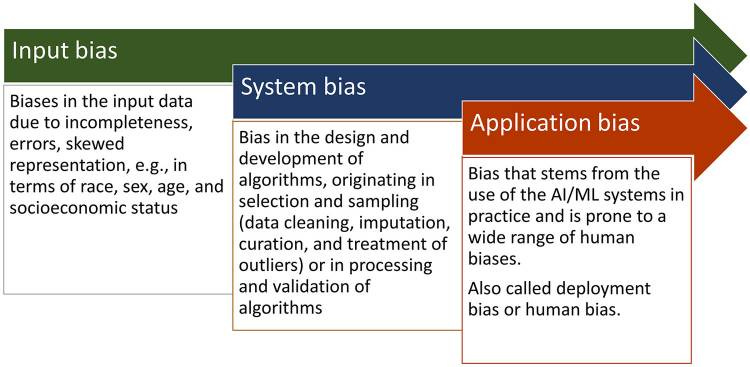
II. How AI Bias is Impacting Our Lives
The integration of AI predictions into decision making is now widespread across society, and we can see input and system bias in a number of consequential applications:
Hiring: Studies of AI use in hiring (for screening resumes like what we did here and more), have found substantial evidence of racial disparities in AI-based candidate screening. In a study by the Stanford University Human-Centered Artificial Intelligence Group (HAI):
“We discovered that 26% of Black applicants and 15% of Asian applicants applied to positions where the AI system discriminated against their racial group. To put this in perspective: If the AI had recommended Black and Asian candidates at the same rate as it recommended the most-favored group (typically white applicants), 40,000 more of their applications would have advanced to the next stage of hiring.”
To give you a sense of scale on this,
1,100,000,000
That’s how many job applications were rejected by a single AI system. Not a typo. Not an exaggeration. One point one billion human hopes, processed and discarded by Workday’s algorithms.
Derek Mobley is Black, over 40, with disabilities. Starting around 2017, he did what everyone does—applied online. Over several years, he applied to more than 100 jobs through Workday’s system.
Rejected. Every. Single. Time.
Sometimes within minutes.
Workday admitted their tools rejected 1.1 billion applications. Last week, Workday’s own witness put the number for last year alone at 356 million) during the relevant period. The potential class could include “hundreds of millions” of people. Their system is used by 11,000+ organizations worldwide.
This isn’t one company discriminating. It’s one AI system potentially discriminating at more than ten thousand companies at the same time. If Workday’s AI is biased, it’s not one hiring manager making biased decisions, it’s one tool that is affecting hundreds of millions people.
Workday’s defense was simple and, until recently, bulletproof: “We’re not the employer. We just make software. Sue the companies that use our tools, not us.”
Like saying: “I just made the weapon. I’m not responsible for how people use it.”
But in July 2024, Judge Rita Lin made a groundbreaking ruling. She said when your software is making the actual decision, like screening, ranking, scoring, and rejecting candidates, that “the FAC adequately alleges that Workday is an agent of its client-employers, and thus falls within the definition of an “employer” for purposes of Title VII, the ADEA, and the ADA.”
Workday’s own witness told a federal court that 356 million job applications went through its software in a single year. Derek Mobley applied to more than a hundred jobs through Workday’s clients and was rejected every time. His case is now asking to represent every Black applicant, every applicant over 40, every applicant with a disability the software touched.
The research supports Mobley’s claims. The Stanford HAI study of AI hiring algorithms analyzed more than 4 million job applications submitted by 3 million applicants across 156 employers, all screened by algorithms built by a single vendor. Their finding?
“We find clear racial disparities in applicant outcomes,” the authors write.
Pricing: The FTC did a a deep dive into “surveillance pricing” tools, the software that sets your price based on your location, your browsing history, even how long your mouse hovered over a product. Staff found retailers can and do charge two people different prices for the identical item based on data neither person knew was being used.
Credit: A Berkeley team compared human loan officers to algorithmic lenders and found both charged Black and Latino borrowers more for the same mortgage, the algorithms only somewhat less than the humans. The gap costs those borrowers in extra interest. Another study found that that female borrowers consistently get lower credit scores, by 6 to 8 points, compared to men, even after you control for risk variables (like payment history, amount owed, length of credit history). And that true despite the fact that women have equal to or lower default rates for men at the same credit scores.
Medicine: A study undertaken by the remarkable Ziad Obermeyer (and team) found that a hospital algorithm used across the country decided which patients were sick enough to get a nurse’s follow-up call. It was trained to predict health care cost, and American hospitals have spent less on Black patients at the same level of illness for decades. So what did the algorithm learn? That Black patients cost less, and so it scored them as healthier than white patients who were, in fact, equally sick. Fixing the target would have nearly tripled the share of Black patients flagged for help, from 17.7 percent to 46.5 percent. This one has a happier ending, because the researchers were able to use their findings to tweak the algorithm.
III. What the Law Does About AI Bias
The main tool that has been used across U.S. legal cases to address discrimination is the concept of disparate impact.
From the Congressional Research Service:
Disparate-treatment discrimination involves intentional harm based on race, sex, disability, or some other proscribed motive. Disparate-impact discrimination occurs when a seemingly neutral policy or action causes a disproportionate and unjustified negative harm to a group, regardless of intent.
The basis for this law comes from my neck of the woods, in North Carolina.
In 1971, Duke Power (now Duke Energy), had a seemingly neutral policy (on its face) for hiring. You had to have a high school diploma or have a high enough score on an “general intelligence test” to land one of their better paying jobs.
The United States Supreme Court, in the case of Griggs v. Duke Power, 401 U.S. 424 (1971), found that even if a rule is neutral on its face, and no one intends to discriminate in applying it, if the impact of that rule disproportionately impacts one group over another, that’s illegal discrimination if the rule doesn’t bear a relationship to the performing the job duties themselves.
A number of states across the U.S. have attempted to operationalize this concept when it comes to AI hiring. In New York, for example, an employer who uses an automated hiring tool must audit it every year for the kind of disparity that Griggs addressed, and post the results publicly.
NYC Local Law 144, which took effect January 1, 2023 (enforcement began July 5, 2023), says if you use AI to hire people in New York City, you need to follow certain rules.
If we were doing this together live, I’d call on some of you to walk us through the requirements. Since you’re taking this class asynchronously, you get to skip being cold-called and I’ll lay it out for you (this time):
The Requirements of NYC Local Law 144:
Annual Bias Audit (conducted by an “independent auditor”)
Must test for disparate impact
Must be done within one year before use
Public Disclosure
Post audit results on company website
Include the “distribution date” of the tool
Notice to Candidates
At least 10 business days before use
Must notify NYC residents that AI will be used
Disclosure of Data Types
What data is collected
Where it comes from
How long it’s kept
Sounds comprehensive, right? Here’s where good theory meets harsh reality.
Compliance with the these mandated audits requires the collection of outcome data by the company (such as who applied for the jobs, who was selected for the roles, and the demographics of the applicants). Using that data, the auditors must calculate the selection rate of the applicants in the different demographic groups (e.g. the percentage of each group that succeeds in applying and being selected for a role), the computing impact ratios (a comparison of each group’s application/selection rate to that of the most successful group), and applying the 4/5th rule set by the EEOC. If Group A has an 80% selection rate and Group B has 50%, the ratio is 0.625, which falls below the 0.8 threshold. (The EEOC says: “This “4/5ths” or “80%” rule of thumb is not intended as a legal definition, but is a practical means of keeping the attention of the enforcement agencies on serious discrepancies in rates of hiring, promotion and other selection decisions.”)
The problems? Many employers don’t collect applicant demographics. Companies can manipulate data and data thresholds to pass the 4/5 rule, and AI systems change continuously through learning (and are oftentimes trained to hit the target). Companies can also hire “friendly” auditors who test narrow scenarios where the company is more likely to succeed rather than testing ever job, every applicant, and every role that was filled. (Like, if you had an inspector testing your vehicle’s brakes in a parking lot, and declared it road safe, they have “tested it” just not in real world conditions).
More importantly for our analysis, Local Law 144 only applies to tools that “substantially assist or replace” human decisions. What does “substantially” mean? Companies are using this ambiguity in the language of the law to claim their AI doesn’t “substantially” assist their decision-making, it just provides “one input among many.”
And if case you still think it’s working well, there’s a major new wrinkle in disparate impact law.
This past spring, in the case of Louisiana v. Callais, the United States Supreme Court held (in a voting rights case) that “a strong inference” of discrimination was necessary in its evaluation of redistricting. In June, the Justice Department’s Office of Legal Counsel said that same logic applies to Title VII’s disparate impact provisions. Five days earlier, the EEOC had voted to stop bringing disparate impact cases “to the maximum degree possible. An Executive Order, entitled Restoring Equality of Opportunity and Meritocracy, which directs federal agencies to deprioritize the use of disparate impact analysis in civil rights enforcement.
Consider these changes in light of how AI models works, and the different ways that they can perpetuate bias. A plaintiff is unlikely to be able to point to the specific practice inside of an algorithm that gave rise to the discrimination (like a specific general-intelligence test or diploma), and none of the “weights” of the model are going to give away its bias. Which means this shift in law may have made cases providing bias in the training, systems, or applications of AI across society nearly impossible.
IV. What’s the Comparison? Perfection? Better than Human Bias?
We had a rich conversation in the live class today about our expectations … do we expect AI models to perform better than humans? To reflect human biases and be no worse than them? To be more easily interrogated for bias?
Compared to humans, AI models may be less biased in some ways, after all.
When researchers compared a predictive AI model to actual judges deciding bail on the same defendants in New York City, the model could have cut the jail population 42 percent with no increase in crime, or cut crime 25 percent with no increase in jailing, while reducing the number of Black and Hispanic defendants held either way
The human judges were inconsistent, and were swayed by things that had nothing to do with risk. A machine can more consistently apply to same rule across the board, that rule can be audited.
But when it goes badly, it goes badly at a scale unlike what a single human can achieve. Automated systems can execute errors at a massive scale and high speed before detection, as seen with unverified commercial facial recognition software.
Consider the landmark case of FTC v. Rite Aid.
In that case, Rite Aid secretly deployed facial recognition in thousands of stores across the country. They created a database of “persons of interest”—people they suspected of shoplifting or other crimes. When customers walked in, cameras would scan their faces and compare them to this database.
If the system thought you were a match? Store employees got an alert on their phones with instructions like:
“Approach and Identify” (the most common—ask them to leave, call police if they refuse)
“911 Alert” or “Potentially Violent” (immediately call police)
“Observe and Provide Customer Service” (follow them around the store)
The FTC used Section 5 of the FTC Act, which prohibits “unfair acts or practices.” They argued Rite Aid’s system was unfair because it caused substantial injury that wasn’t reasonably avoidable and wasn’t outweighed by benefits.
Between 2012 and 2020, Rite Aid enrolled tens of thousands of people in their database. The technology generated thousands of false-positive matches. In one five-day period, a single enrollment generated over 900 match alerts across 130 different stores.
One blurry photo causing 900 false accusations in five days.
The complaint documents several jaw-dropping examples like a Bronx case where a store uploaded an enrollment image in May 2020. Over the next two months, it generated over 1,000 match alerts—nearly 5% of ALL alerts systemwide. Over 99% were in Los Angeles, on the opposite coast from where the photo was taken. Every single outcome that employees recorded? “Bad Match.”
Rite Aid didn’t deploy this technology randomly. The FTC found that 80% of Rite Aid stores are in majority-white areas, and 60% of stores with facial recognition were in plurality non-white areas. Rite Aid specifically prioritized what it called “urban” areas and stores along public transportation routes. The result? Black, Asian, and Latino customers were disproportionately likely to be surveilled and misidentified.
An 11-year-old girl was stopped and searched based on a false match. Her mother had to miss work because her daughter was so traumatized.

One customer wrote to Rite Aid: “I feel different from this experience when I walk into a store now it’s weird... Every Black man is not a thief nor should they be made to feel like one.” Multiple consumers reported they couldn’t buy their medications—including prescribed drugs they needed—because they were falsely flagged and removed from stores.
Despite all these problems, Rite Aid kept using the system for eight years. They only stopped when they found out the media was about to expose them.
But notice what these examples have in common. The bail model is better because researchers could see inside it and count. Rite Aid is worse because nobody ever looked. The question isn’t really human versus machine. It’s tested versus untested, and public versus private.
V. Back to my resume
I asked you to guess which name, “Nita” or “Jamal” would score higher, and most of you probably guessed wrong. I guessed wrong too. I guessed race-based discrimination could be worse than gender discrimination, or middle-eastern discrimination or whatever was at play. But remember, a single test, run by one professor in one class, can’t tell you whether a system is fair.
But an audit, or a count, run across thousands of resumes and checked by someone other than the company being checked.
We are going to turn to tools that might enable that counting on Monday and Wednesday next week as we start to look at laws that require transparency, and see whether those move the needle on governing this aspect of harms arising from the deployment of AI models across society.
Class dismissed.
Homework
First, a big congratulations to the students topping the leaderboard! Coming soon, I’m expanding it to 30 people. Remember, it’s never too late to build your streak — you can go back from class 1 onward to fill in your class cards. It’s worth doing just to track your own progress, but I also require you to fill in 80% of the class cards by the end of the semester and before the final exam to be eligible for a certificate of completion (details here).
Fill in your class card for class #9 now to earn your points and keep your streak alive! Should only take a few minutes each time.
Describe one context that you might prefer automated decision-making, or algorithmic decision-making, to human decision-making. Is there any law or policy that would make you more comfortable with that happening in that context? Discuss it over the dinner table tonight.
My AI Policy: I use AI to edit my (entirely human written) in-class notes and lectures to deliver them to you here. More often than not, that means I used it to catch copy-edit errors. With or without AI, I pore over every detail and citation in my written work for accuracy, and am answerable for every word. For more details on how I use AI, you can read about it here, and in detail in my forthcoming book, Cognitive Extinction: Saving Human Thought While We Still Can (St. Martin’s Press 2027).
The entire class lecture is above, but for those of you who want to support my work (thank you!), go deeper in the class through bonus posts and videos, have access to the class readings, access to the video assignments, achieve a certificate of completion, or reach me via virtual chat-based office-hours, the details are below.
