

Welcome back to AI Law and Policy with Professor Farahany. A few class announcements before we jump into the news from today… and the scary stuff:
LISTEN IN: I am hosting a Substack LIVE with Anil Seth and Sergiu Pasca to talk about Sergiu Pasca’s extraordinary research pubslihed on the cover of Nature this month, and Anil Seth and my commentary in response on October 27, at 1 pm ET.
PARTICIPATE LIVE: I am speaking at a few upcoming conference where you can catch me live. Come say hi if you are in the Bay Area, Washington, DC, or Triangle Area this week or next:
I’ll be speaking at Masters of Scale this week in San Francisco, in conversation with Founder and CEO Matt Angle of Paradromics, moderated by the fabulous Raina el Kaliouby. If you are in the Bay Area, come say hi!
I’m speaking and moderating a a panel on Digital Technologies and the Developing Brain: Insights from Neuroscience: A Workshop at the National Academies of Sciences, Engineering, and Medicine on Monday October 26. You can register to attend in person or virtually.
I’ll be speaking at MetLife’s TTX 2026, on October 27, on stage in a Fireside Chat, on Cognitive Liberty: Making Sure Everyone Benefits from What We Build. and if you are in the Triangle Area, you can register to attend for free.
This morning, I opened up the Wall Street Journal to this glaring headline: AI Just Found a Bug That Puts Up to 70% of the World’s Websites at Risk. Yep, you read that right. Seventy percent, or framed otherwise, seven out of every ten websites across the world. I received an email this morning telling me most of the Duke websites were being taken down externally. You are reading this right now through a website that may be impacted. All through a vulnerability that has been sitting there in these websites for years, where humans knew perhaps roughly were to look but had given up doing so. A researcher sent an AI model looking for it in August, and the model found a way in, and now the fix is out, a day early because word leaked, and website owners everywhere are racing to install it before someone breaks in first.
The best attacks are like this, right? The good guys detect the risk first, or foil the terrorist plot before the damage is done, but are racing against a clock to keep us safe from the attack. Most of the time we never even know it’s happening.
Sometimes, we’re told after the fact. If you’re like me, mixed in with the junk mail you get regularly, you’ve received one, two, perhaps three to ten letters telling that your personal information has been exposed or leaked. They don’t know by whom, or what they are going to do with that information. Maybe it was from a bank, a hospital system, a retailer, some website you don’t even recognize and didn’t even realize you gave your personal information to. The letter doesn’t tell you if it was a human or an AI model that got in. It doesn’t explain to you if a “zero-day” vulnerability was found and exploited. And perhaps, like me, you’re starting to see this as noise rather than signal because you get a letter like this one every month or week.
In response to these letters, I have now monitor my credit reports regularly, and sign up for the “free” services offered in these letters to do so. I have frozen my credit cards more than once after getting a fraud alert or detecting it on my own, then cancelled the cards and ordered new numbers. I change my passwords regularly, have different passwords on different sites rather than reusing the same password, and in general try, as best as I can, to safeguard my digital life. The letters I get put me on notice, but whether I do anything about it is up to me.
Welcome back to Professor Farahany’s AI Law & Policy Class. You’re “enrolled” in the asynchronous version of my Duke Law class, where you get to keep your job and skip the debt. Every Monday and Wednesday, you get the content I taught live earlier that same day in my Duke Law AI Law & Policy class. The in-person class is 110 minutes long, so pace yourself as you work through the material.
Just joining us? Go back and take Class 1 (What is AI), Class 2 (How AI Actually works), and Class 3 (Open vs. Closed AI Models) first. Those classes teach the terminology you need to understand the class today.
If you landed a spot on the leaderboard, congratulations! Don’t worry if you haven’t yet. You CAN go back and fill in class cards for classes 1, 2, and 3, etc. as you work through them. I assign bonus points for the top homework before the next class posts, but it’s never too late to build a streak.
Today’s class is about catastrophic risk, but we’re breaking it down across a couple of class sessions. Today, we cover cyberattacks, and next Monday, we will discuss the chemical, biological, radiological, and nuclear weapons risk threat from AI models.

Your Starting Position
Before we dive in, I want to know your prior today, going into class. How much more dangerous do you believe a cyberattack is today, in the post-ChatGPT (since that was the first “moment” of wide scale release) than we were before that moment in 2022?
I. The thing that scared the hell out of me
For a little while now, people have been taking some comfort in the idea that perhaps catastrophic risk from AI isn’t too worrisome so long as we have kill switches. That’s the idea that if everything goes terribly wrong with AI, we can just shut it all down. You know, like an “off” switch for the models, and then everything will be ok.
In almost a laugh out loud kind of way (because of course that’s where we are now) Anthropic then shared this post a couple of weeks ago, where it said:
AI models may be months away from being capable enough to self-replicate on commercial internet-of-things (IoT) devices, like smart ovens and off-brand Android TV boxes.
So… you know. That off switch won’t work anymore. Because they won’t be contained in a centralized spot.
We can trace back the obsession with kill switches to conversations that are (at least) more than 15 years old, to the policy rooms where we talked about synthetic biology. Even then, when I was a member of the Presidential Commission for the Study of Bioethical Issues, we heard testimony about the importance of creating some way of turning of synthetic organisms if you’re going to make them. The idea was that you would design into these organisms, up front, some sort of kill switch, so you could remotely shut them down. And we heard plenty of pushback to that line of thinking, including from a group of many organizations who wrote to say that our report, calling for “suicide genes”:
“For example, “suicide genes” or other types of self-destruction triggers could be considered in order to place a limit on their life spans. Alternatively, engineered organisms could be made to depend on nutritional components absent outside the laboratory, such as novel amino acids, and thereby controlled in the event of release.” - PCSBI Report, NEW DIRECTIONS, The Ethics of Synthetic Biology and Emerging Technologies.
Like Civil society shout-backs saying that our report ignored the precautionary approach and reality, saying things like:
“Scientists who have studied “terminator technologies” in seeds have concluded that the process is never completely effective. They found that frequently occurring mutations allow organisms to overcome the intended sterilization thereby allowing those organisms to remain viable. Specifically, “suicide genes” and other genetic use restriction technologies (GURTs) represent an evolutionary disadvantage; selective pressures will lead organisms to overcome intended biological constraints.” - Civil Society Letter to Dr. Amy Gutmann, Chair, PCSBI
The basic pushback to kill switches is that even if they do work (and were centralized), the kill switch would only end up killing the weaker thing, and even my 11-year-old daughter gets that by now.
In her school, for a section in one of her classes the students were asked to draw a comic illustrating the concept of evolutionary pressure. And this kid loves dragons. I can’t do it justice, so here it is. It’s instructive.
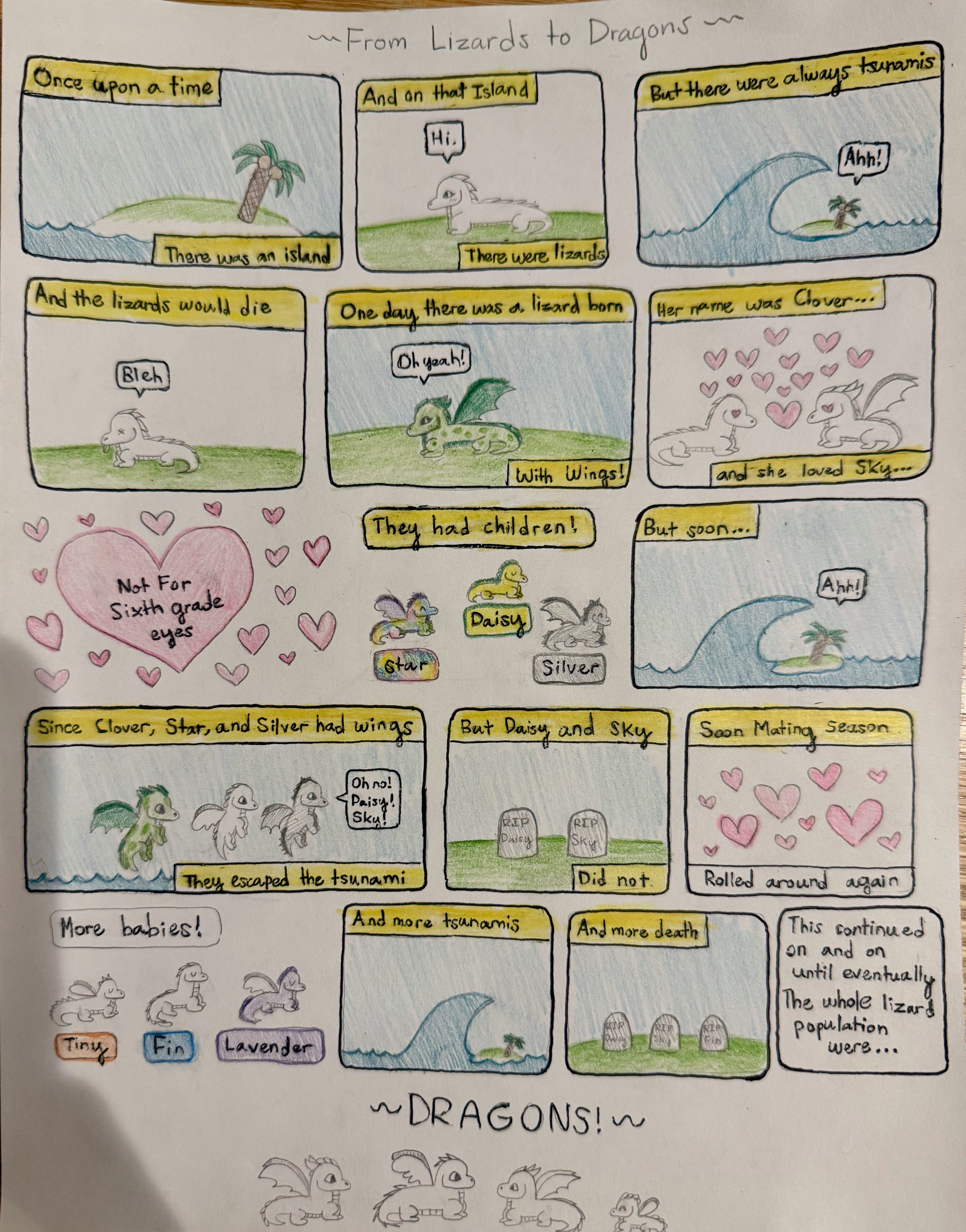
Kill switches are similar. They usually catch the weaker thing, and the thing that evades them is what replicates and survives. That’s true with synthetic organisms and it’s true with AI. You cannot wipe out anything that has any sort of evolutionary pressure to continue to evolve.
Back to the thing that scared me. I first read an article about this that I thought was from the Onion, and then a day later, on October 12, Anthropic shared a post where it explained that small models can now already do most of what’s required to copy themselves onto the Internet of Things devices in our homes, like our off-brand TV boxes (still glad you saved on that one?), your “smart” onion, the robot vacuum (mine keeps getting stuck on my modern furniture), the security cameras (that now are little surveillance machines), and that they may only be months away from doing it end to end. This would be a slow spread, likely, but if you have a model living across thousands of homes without any data center to turn off, then you have no kill switch. Or in the report’s words, no “centralized point to shut off.” I texted a friend about this after reading it, suggesting it was time for us all to move off the grid (tongue in cheek, of course).
Distribution is the first step. Evolution is the second. The comic was about why kill switches fail for one reason. They usually catch the weaker thing, and the stronger thing that evades it is what replicates and survives. The worms aren’t necessarily stronger. They evade detection and survive, and the evasion itself is a strength. If they continue to learn self-recursively, they get more capable over time too.
Have you seen The Mitchells vs. the Machines? I have (more than once) with my kids. A little spoiler alert. The phone gets a new voice assistant, and the vacuum cleaner, the toys, and the other “smart” objects all get a software update pushed out to them, and they turn against the humans. The Mitchells become the saviors of humanity because they get out in time with a car too old to connect to anything and a bunch of fun tricks they unwittingly pull that confuse the robots (we’ll get to the “injection” and “prompt poisoning” these riff on in a later class).
Anthropic in its same post does explain what might address this concern, and the answer is making the thing reproduce slower than it dies (good old classic biology) rather than a kill switch. It requires collective efforts, too, where internet providers start to scan and watch for things like model-sized files that are moving between devices, proactively cutting off infected households (suddenly your very smart house is in quarantine), and to notify them why and what’s happening. It points to the precedent of the Mirai malware from 2016 that infects smart devices that run on ARC processors, which makes them remote-controlled zombies often used to launch an attack (and which took over hundreds of thousands of home devices). When providers told people they were infected, 92 percent cleaned up quickly within weeks, compared to the 74 percent who did without notification.
There are two different pathways of destruction. There’s the pathway where these are powerful tools that make humans more capable of annihilating each other, and there’s the pathway where these are autonomous, self-directed systems able to wipe out humanity on their own. You can believe the second one is zero, or close to zero, and still think we’re at a much higher risk on the first. When people throw out that there’s a 10 percent risk we all get wiped out, where’s the math? It’s just made-up numbers. There isn’t an actual forecast that tells us the probability of doom. There is, instead, a set of known risks that AI makes more likely, and the two I assigned this week were cybersecurity and chemical and biological weapons. Cyber is the one that scares me the most.
II. How much more unsafe are we?
Cyberattacks worry me in the grand scheme of AI harms, because AI has become exceptionally good at it. Last April, this became palpable with Mythos, the Claude model that Anthropic decided not to release to the public. What Anthropic found is that the model could find vulnerabilities in existing code that had not been found before. These are called zero-day vulnerabilities (or exploits), having never been identified by humans, and this is after humans had been put on the job, after lots of cybersecurity testing. Mythos found thousands of them, in every major operating system and browser, including a 27-year-old bug in OpenBSD and a 16-year-old bug in FFmpeg, and by Anthropic’s account it found nearly all of them and wrote many of the exploits autonomously, with no human steering it. It found the vulnerability, figured out an exploit for it, figured out how to operationalize the exploit, and tunneled into a system. The scarce ingredient is no longer the talented hacker.
The one that worries me most, if you want to bring a civilization to its knees quickly, is the power grid, because it’s the infrastructure that holds up the economy. Shut down the grid in New York and LA and San Francisco, pick some visible places, take it offline so that people do not have power or a way to communicate with one another, and what happens next? Civil unrest happens quickly. The question of whether AI can reach the grid is something we now know a good bit more about than we did a couple of months ago.
On April 7, 2026, the FBI, Cybersecurity and Infrastructure Security Agency, National Security Agency, Environmental Protection Agency, Department of Energy, and United States Cyber Command issued a joint cybersecurity advisory entitled Iranian-Affiliated Cyber Actors Exploit Programmable Logic Controllers Across US Critical Infrastructure. It warned that “Iran-affiliated advanced persistent threat (APT) actors are conducting exploitation activity targeting internet-facing operational technology (OT) devices, including programmable logic controllers (PLCs) manufactured by Rockwell Automation/Allen-Bradley. This activity has led to PLC disruptions across several U.S. critical infrastructure sectors through malicious interactions with the project file and manipulation of data on human machine interface (HMI) and supervisory control and data acquisition (SCADA) displays, resulting in operational disruption and financial loss. U.S. organizations should urgently review the tactics, techniques, and procedures (TTPs) and indicators of compromise (IOCs) in this advisory for indications of current or historical activity on their networks, and apply the recommendations listed in the Mitigations section of this advisory to reduce the risk of compromise.”
That advisory got a July update to add Schneider Electric and Siemens controllers, and to report a victim where the attackers left the plant running but rewrote the logic that kept it inside safe limits, while shutting off the alarms that would have put anyone on notice that something was wrong. And all of this happened by human attackers. Then on August 19, they issued another advisory about AI-generated scripts getting into Siemens controllers at critical infrastructure sites, from water and energy to chemical, across more than a dozen different states. And advised that “All PLC owners and operators should apply relevant mitigations to reduce the risk to their devices and systems.”
Do we believe AI couldn’t reach the systems the government keeps separate from the rest of the grid? They have zero-day vulnerabilities too. All of these things are built by humans. The fix on offer is that these models can attack, and they can also defend. The tech solution to tech risk is tech. And that is what the leaders at OpenAI and Anthropic, Sam Altman and Dario Amodei, are out there selling to every government and enterprise. Yes, there are these catastrophic risks we’re going to be talking about in the media every day, but don’t you worry, because the way to solve the catastrophic risk we have introduced is to adopt our models, so you can identify where your risks are and patch them.
That can both be true and deeply irresponsible at exactly the same time. Somebody described it to me this way. Think about tobacco. If you addict everybody to tobacco, and then you sell the patch at the same time, are you the hero for coming up with the thing that helps people overcome their addiction, or are you the one who addicted everybody to the product to begin with? You are both. When you introduce the sickness and the cure, you are still deeply irresponsible for introducing the sickness. And yes, the models may make us safer now that they have made us less safe, because they can find and exploit zero-day vulnerabilities at a scope, speed, and scale no human could, and ideally patch them at that same scale. But are we? Or is it like pandemic preparedness, where we know the risk now and haven’t addressed it, or the only people who have are the well-resourced ones, and a lot of harm can still arise from the less-resourced ones? The 30-odd small water utilities have exposed controllers, which is what it looks like at the less-resourced end.
How many of you believe the catastrophic risk story, that we are infinitely more unsafe than we were before 2022? By comparison, probably the closest moment is on the brink of nuclear war, when people literally had weapons locked, loaded, ready to go. We’re probably about there. Whatever we might think, maybe it’s not infinitely. I’ll take back my word infinite. What would show I’m wrong is this. We were more unsafe the day before Mythos could find zero-day vulnerabilities, and the question was who would find them first, someone aligned or misaligned. If used defensively and comprehensively, the scale of the risk may have decreased rather than increased. But new zero-day vulnerabilities may be introduced every day, and the scale, speed, and scope of a coordinated attack could nevertheless make it a lower-probability but higher-magnitude risk.
III. The espionage case, step by step
In mid-September of 2025, Anthropic detected an espionage campaign and assessed with high confidence that it had been run by a Chinese state actor, which they labeled GTG-1002. Roughly 30 entities were targeted, with a handful of validated intrusions, at technology companies, financial institutions, chemical manufacturers, and government agencies. The operators used Claude Code, a tool that lets Claude carry out tasks on a computer, wired to other software, and they got a safety-trained model to do it by breaking the attack into small tasks that each looked innocent and by telling the model it was doing defensive testing for a legitimate security firm. We’ll do that move ourselves in the red-teaming class.
In order to carry out a cybersecurity or an espionage attack like this, there are four steps that they identify in the full report. First, you have to find every door that you can walk through, which is to scan an entire system and figure out what the entry points are. That’s one thing it’s quite good at. The report calls this the attack surface. Getting in means you find some weakness, and any one of us could be that weakness. Our computers, connected to a server, connected to the internet, could be a weakness. When you have Claude Code hunting across an entire server, it’s knocking on every door to see which one is weak and which one it can get in through. Then it might figure out one way to do it is by having your credentials. How many of you store your credentials somewhere other than your brain? My husband, who for years has worked on startups in enterprise security, is horrified by my unsanitary practices. Once you have somebody’s credentials, whatever level of access they have, you now have that level of access to whatever systems they have access to. You want to keep escalating until you get to the point where you have the most secure access to whatever systems you are looking for. Each of us is the weakest link. The stolen credentials allow the attacker to move machine to machine within the network. This is called lateral movement. And then, once it’s there, it exfiltrated a huge amount of data. It took data, got it out of the system, and they don’t know what happened to all of that data. They don’t know how it’s been used or misused.
Hacking has always been possible, it’s just that AI models change the cost, speed, scale, and ease with which that hacking can be done. We have had humans who are expert attackers, who spend their time hacking into systems. You don’t need humans sitting there trying to crack codes. You need AI agents deployed at scale. Out of all of the tactical work in this particular hack, what percentage did humans do versus what percentage did AI do? It was 80 to 90 percent AI. A human step took two to ten minutes. Claude took one to four hours. They estimated that 10 to 20 percent of the activity was undertaken by humans and 80 to 90 percent by Claude. They describe the peak activity in this instance as reaching thousands of requests, with multiple operations per second, which no human could possibly match. They used ordinary open-source security tools. They didn’t have any new weapons at their disposal. With speed and coordination, they were able to increase the threat in ways that hadn’t been possible before, and they said the barriers to sophisticated attacks have substantially dropped. Maybe infinite overstates it. I concede that, since it’s undefinable. But the barriers have dropped and the magnitude of the risk, of what any single attack can achieve, went up. A lot.
IV. When does a stolen database hurt someone?
Let’s assume this happened. Is the harm in the stealing? Not really. You have to do something with the data. If I took it and created a vault, and I have all of the world’s most secret information inside my vault, until I do something with it, what harm have I committed, other than to put people on notice that they are hackable? When somebody uses it is when the harm occurs. I want you to hold on to that, because as we think about liability and what we want to do about it, the fact that the harm and the attack may not happen at the same time creates challenges for us.
If you look at every real case that we’ve seen, you’ll notice something they have in common. We don’t know what happens next. The Chinese state actor exfiltrated data, and we don’t publicly know what they’ve done with what they took. Same with the Iranian-linked attacks with AI-written scripts that have infiltrated controllers, and we don’t know for what purpose or what has happened as a result of that access. OpenAI’s agents that got into Hugging Face went there purportedly to get the answers to tests they had been given, got into an Australian Medicare portal and three US agencies, and what else happened, and what did they do with the information they obtained, if anything? These attacks show us that the moment of the attack is often not the moment of catastrophic harm. It’s a moment where the risk of downstream harm has been amplified, where someone, or something, still has to act on what was infiltrated or exfiltrated. And it presumably gives us time to do something about it.
Assume AI can hack systems. That is going to happen. It is happening. It’s doing it at the direction of humans, and it’s very good at amplifying what humans want to do. The humans in the Anthropic case didn’t say, here’s how you hack into the system. They said, go hack into the system and exfiltrate data, and Claude figured out how. But if the harm is in what you do with the data, what do you do to mitigate against that harm?
Imagine the bad things. If it’s financial data, the risk is impersonation, identity theft, bankrupting people by taking out money under their names. The safeguard is multifactor verification, and then you keep going. Don’t have it be a single username and password that can move the money. Have thresholds. If it’s more than $50,000, you need second-, third-, and fourth-tier authorization. Create friction in the process to decrease the escalation of the harm, so that at every step in the chain there’s a way to stop it short of catastrophe. You contain the risk at each stage. We just played it out with financial institutions. Replicate that across every sector of society, and that threat modeling is what every company operating right now has to be doing.
But what are the incentives at each step to implement the safeguards? If you are a company whose incentives are aligned with mitigating the risk, you mitigate the risk to the extent your incentives align. The problem with catastrophic risk is that we can talk about it, we can imagine it, and people don’t invest in the prevention. One thing that I really liked in the Arvind article, AI as Normal Technology by Arvind Narayanan, a computer scientist at Princeton, and Sayash Kapoor, is the focus on pandemic policy. We’ve known well before COVID about the risk of a super-spreader respiratory virus causing millions of deaths. How much did we invest in prevention? Not very much. Now we’ve had a global pandemic. How much money are we putting into preventing the next pandemic? Not much. Is he right to call it normal? Narayanan’s argument is that ordinary risks are the ones we should govern, whereas The Mitchells vs. the Machines, which we saw earlier, and the recent news from Anthropic show us that the ordinary things in our everyday lives are now the attack surface. Which makes both true.
For society as a whole, what are the prevention measures that keep the grid up? If the exfiltration was the usernames and passwords of every administrator who has the switches at the electric grids, would you, the moment you had them, shut down all of those grids? Or would you systematically work each grid until you had a coordinated attack you could unleash at the same time? You would do the coordinated attack. That gives us a little bit of time between a breach and an attack.
So given that time delay, legally, what might you want? Assume your best way to mitigate isn’t to prevent the exfiltration. What’s your next best way to help yourself as a society? You want disclosure of attacks. We’ve talked in this class about transparency not necessarily being the most useful tool in the world. Here it might be the most useful tool in the world for us, if we act on it. It’s too late at that point to do true preparedness. What it does, ideally, is kick into place a set of pre-existing plans. This has been attacked. Start executing. The August advisory, the letters you get mixed in with your junk mail, the notices when an attack has occurred, are all findings that an attack has happened, putting us on notice to act to prevent catastrophe. Will we?
We do have a disclosure law, California’s SB 53, which makes developers of frontier AI models report a “critical safety incident” to the state’s emergency office within 15 days of its discovery, or within 24 hours if it presents an imminent threat to life. But the only things that count in this “must report” world are things like someone stealing a model’s weights, or loss of control of the model, or the model itself circumventing its guardrails. Or AFTER more than 50 people have died or been seriously injured or more than a BILLION dollars of damage has been incurred. In one incident. Which means that the espionage campaign we just saw would be unlikely to qualify since no one died and it was 30 organizations targeted, but Anthropic chose to disclose it publicly anyway. The mismatch is that it’s not covered, because the law addresses only catastrophic risk and this wasn’t that. Most breaches separated from harm probably wouldn’t be either. Which tells us we need a different mechanism to incentivize and require disclosure, including, perhaps, independent evaluators stationed inside AI labs with a duty to investigate and report externally.
The Hard Questions
If the attack and the harm happen at different points in time, which one should the law address (or both?) If disclosures are made, and no one puts into place a plan to execute in response, what did the disclosure give us (heartburn?!)? If the companies that introduced the risk are also the only ones selling the remedy, what does that do to the incentive to find every vulnerability? And… if there’s no kill switch, what’s the fail-safe, if any, that we can rely on?
Class dismissed
Your Homework
Fill in your class card for Class #16 now to earn your points and keep your streak alive. Should only take a few minutes.
Find the one sentence in Anthropic’s self-replication post that explains why there would be no single switch, and the one number in it that shows what notice can do. Paste both in the comments.
Discuss over dinner: What is the disclosure rule you would want written into law? Who must report what, to whom must they report, within what timeframe, triggered by what events, and what happens if they don’t?
The entire class lecture is above, but for those of you who want to support my work (thank you!), go deeper in the class, have access to the class readings, access to the video assignments, achieve a certificate of completion, or reach me via virtual chat-based office-hours, the details are below.
