

In 1949, Edmund Callis Berkeley wrote a popular book called GIANT BRAINS: Or Machines that Think. In the preface he wrote:
“The subject of this book is a type of machine that comes closer to being a brain that thinks than any machine ever did before 1940. These new machines are called sometimes mechanical brains and sometimes sequence-controlled calculators and sometimes by other names. Essentially, though, they are machines that can handle information with great skill and great speed. And that power is very similar to the power of a brain.”
Today, we call those machines calculators and nobody thinks that calculators think. Or that calculators need rights. Or that they should be held legally responsible for a miscalculation. (If a battery overheats and explodes, we hold the manufacturer responsible for it).
Today, we’ve moved from calculators to much more sophisticated machines, which is the topic of our class this semester.
Welcome to Duke Law (You + My In-Person Students)
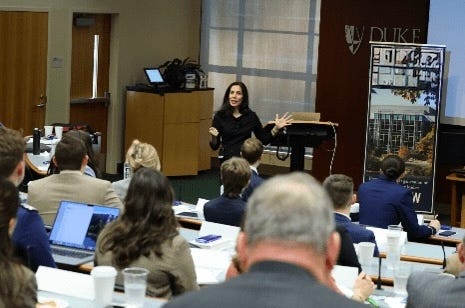
Starting today, you’re “enrolled” as a virtual student in my 2026 AI Law & Policy course at Duke Law School, where you will be learning the same material my in-person Duke Law students learn. They join me in person every Monday and Wednesday from 8:30 a.m.-10:20 a.m. Later that same day, I bring that lecture to you here, along with what happened in the live class. The revelations, the confusion, the “aha” moments, and yes, actual legal education. New this year, I’m offering a leaderboard to track your progress (available to all, free or paid subscribers). And even a certificate of completion if you make it all the way through the class, and pass the midterm and final exam (for paid subscribers).
Think of this series as getting to audit my Duke Law class, for the price of a cup of coffee.
I. Today’s Opening Discussion: “What Is AI?”
We did some basic orientation in class today first: talking through the syllabus, laptop policy (your in-person class voted to keep laptops open, and designate a tech distraction-free zone), AI policy (use it to enhance and extend, but not substitute for your thinking), and then got into the reading for today.
We started where I want you to start — which is to take 90 seconds to write down your definition of artificial intelligence. Seriously, grab a pen or type it out on your computer.
Done? Hold onto your definition, because I’m going to want you to refine it later today.
When your in-person counterparts compared their definitions with each other, there was some interesting convergence and divergence. “Software that learns.” “Machines that think.” “Advanced pattern recognition.” No two answers matched perfectly although one pairing aligned somewhat, and focused on the generative nature of novel LLMs.
That’s pretty consistent with what we see even in an area steeped in AI, the Bay area. Last week, CBS Bay News reporters walked around the Bay Area and asked people, What is AI? They got back answers like:
“It’s a whole lot of unknowns”
“I’m afraid it’s going to take away jobs”
“It’s a really really really smart computer”
“It helps us look up things faster”
CBS News then turned to AI experts, who offered these definitions:
NASA: “Artificial intelligence refers to computer systems that can perform complex tasks normally done by human reasoning, decision making, creating, etc.”
“It’s an umbrella term for many different types of advances”
“It’s a shifting definition, because every time we solve something, the target moves”
So here’s my question to you: If it’s a whole lot of unknowns or an umbrella term, how do we write laws for something we can’t even define?
Ok, let’s try this another way. How would you answer the following questions on whether or not they are “AI”?
We tested our intuitions in the live class, and I want you to do the same first, before comparing your answers to my in-person students. You are a cohort now, and I’ll help you see how your answers line up with the in-person cohort.
Which of the following technologies would you consider AI?
In person students thought obviously AI, with 100% of them voting that it was AI. But what makes it so obvious? Will we one day think of these like we have come to regard calculators? Speaking of calculators:
I’m going to hold back for now what the in-person students said. I’m asking you to predict what your in-person counterparts said on your class attendance card below.
In-person students split on this one, for an interesting reason. The 25% who said “not AI” thought it was pulling recommendations from a closed universe, rather than generating new movies for you to watch.
In-person students thought only the summary at the top counted as AI, not the search itself.
Here’s the thing: what would have counted as AI yesterday is now just mundane software (like search engines). Given the changing conceptions of AI, how do we write laws that won’t be obsolete by the time you all (yes I mean you, too) graduate?
II. Are the most advanced AI systems, like LLMs, more than “just” a computational system?
Let’s take large language models like Claude, ChatGPT, and Gemini. Most of you think that these are AI. Do you believe those systems understand you? I’m not asking you if they can reason. I’m asking you if you think that they understand?
To answer this question, take a quick detour with me and notice where that question lands in your body. (Yep, drag your attention away from the screen and focus on your physical body for a moment, and notice where you “feel” the question. Do you have a pit in your stomach? A clenching in your chest? Can you “feel” your brain whirring and neurons firing?).
Whatever you decide about whether AI can understand, how you and I understand is through embodied cognition. That matters to how we interpret input from the world around us. (Check out Anil Seth’s TED talk on why he thinks AI isn’t going to become conscious. Spoiler alert: he focuses on embodiment).
This isn’t a random sidebar on the philosophy of consciousness (but seriously, let’s do that together sometime). How we regard AI matters a lot for how we think about concepts of legal responsibility, and even whether it has rights. After all, things can and HAVE gone wrong with AI. And whether AI understands has some bearing on who (or what) is legally responsible for the bad result. Let’s see what some of the thinkers in our reading said about this issue.
Geoffrey Hinton (the “Godfather of AI” who won the 2024 Nobel Prize in Physics for foundational discoveries and inventions in statistical physics that enable machine learning with artificial neural networks): “They definitely understand. They are intelligent.” More recently, he went further still and said “they’re beings like us,” and “I believe they’re already conscious.”
The ‘Stochastic Parrot’ authors (including the fabulous Emily Bender): say that large language models are just predicting the next most likely word based on statistics. She and her colleagues argue that “a model trained exclusively on text will only ever learn the form of a language, not its meaning.”
The Turing Test: You’ve probably heard of this one. In 1950, Alan Turing published a paper asking Can Machines Think? For Alan, he thought that the appearance of intelligence was enough, and if a human couldn’t tell whether the output was from a human or a machine, it passed the “Turing test.” So maybe fake it until you make it?
Mustafa Suleyman, CEO of Microsoft AI, posted a provocative essay on “seemingly conscious AI,” arguing that we should be building AI for humans, not ones that seem like humans. (A nice example of building for humans without making the machine human-like is ElliQ). Suleyman unpacked this in greater detail with colleagues in a paper in AI and Ethics in August 2026, laying out the aspects of current AI design that may lead us to believe that they are conscious and the risks it introduces. (Sidebar: Even Suleyman has described AI as a new kind of digital species.) Here’s figure 1 from the article:
Why this matters for law and policy. If Hinton’s right, we might need to consider AI rights, AI testimony, AI liability. If the critics are right, it’s just software, a tool like any other, where humans bear full responsibility for its use. And if Mustafa Suleyman and his colleagues are right, then designing these tools as seemingly conscious brings legal risks that we should be addressing.
III. IF WE CAN’T DEFINE IT, CAN WE GOVERN IT?
Helen Toner (yes, from the OpenAI board drama) offers a fascinating metaphor in her TED talk, arguing that governing AI is like “driving down a road with unexpected twists and turns.”
Her point is that we don’t need perfect foresight or even a perfect understanding of what AI is to govern AI, we need a clear windshield (transparency into what AI systems are doing), good steering (adaptive governance that can respond quickly), and working brakes (kills switches and safety measures. (We’ll come back to Toner in a later lecture on China, and look at her recent Senate testimony on the issue).
But imagine driving when the road keeps morphing before your eyes (AI capabilities are changing monthly), your windshield is fogged over (we have a “black box” problem), and there are different passengers claim you are in a different vehicle or not in a vehicle at all (the definitional problem).
That’s AI governance in 2026.

IV. Learning the Vocabulary We Need
Since you’re now effectively a Duke Law student, you should know that all I really expect you to know from today is that defining AI is a problem we have to tackle for law.
But I also want you to start to familiarize yourself with some of the basic vocabulary. I promise we will unpack these over the next few lectures, but it’s good to start to familiarize yourself with the terms. Because we can’t read and understand the laws and issues behind them if we don’t understand the terminology inside of them. I have included some short video links that the in-person students watched for the students who want to go further. I highly recommend you do the same if you want to really understand this material.
Machine Learning: a subset of AI where a machine is trained to learn patterns from example it is trained on.
GANs (Generative Adversarial Networks): Think of it like two AI systems that fight each other, with one creating fake content and the other one trying to detect it as fake or real. They train and iterate with each other until the fakes are indistinguishable from the real one. And as you might guess, this introduces all sorts of legal nightmares, as courts increasingly encounter AI-generated evidence that, if the model succeeds, should be indistinguishable from real evidence. Newer models have taken over this process, which we will learn about as we study deepfakes, but the adversarial idea helps you understand the foundations of this.
The “Black Box” Problem: AI makes decisions, but no one, not even its creators, can explain why and how it made its decisions. This is the “black box” where you input training data, there is a lot happening under the hood, and all we see is the output. Now, imagine a judge using an AI for determining the sentence of a criminal offender, and while relying upon it cannot explain the reasoning about why or how the system arrived at the chosen sentence or parole decision. Is this a violation of due process? Probably. But as we’ll see, the black box is getting more interesting and a little light is coming in these days.
Natural Language Processing (NLP): This is how AI “understands” human language, by breaking it into tokens and patterns. And the amazing thing is that your next contract (or last one) might be or have been reviewed by NLP. Which has to make you wonder (as the now-law-student that you are), when the AI system overlooks a crucial clause in its review, who’s liable? (The lawyer, for now).
LLMs: “A large language model (LLM) is a type of AI that can process and produce natural language text. It learns from a massive amount of data gathered from sources like books, articles, webpages, and images to discover patterns and rules of language.”
Words that are coming: tokenization, embeddings, attention, foundation models, input layers, output layers.
V. Your Homework (Yes, I mean you, virtual student)
Write a one-paragraph legal definition of AI that: (1) Won’t become obsolete as technology advances (2) Addresses whether “understanding” matters legally (3) Clearly identifies what we will and won’t regulate as “AI”
VI. Your Leaderboard Seat If You Want One
(1) Leaderboard (for everyone): Last year, many of the students in the virtual cohort asked if there was a way to track their progress. So I am trying out something new this year, which is to give a way to track your progress toward completion of this course. Each class, I will have a class attendance card for you to fill out, which connects to a ledger I am keeping for the class. Completing the card earns you 10 points, filling in the homework earns you 5 points more, making an accurate prediction earns you 10 more points, and taking consecutive classes builds you a streak, where keeping your streak earns you 5 points. If I have selected your homework answer to feature, you get an additional 50 points. You choose your display name and I will be featuring a leaderboard on my Substack homepage.
Fill your class 1 card out here! (Make sure to use the same Google account all semester, since I link your student ID to your email address).
(2) Certification of Completion: At the end of the semester, there is also an option for paid subscribers who have completed 80 percent of the class cards, to take (and pass) a midterm exam and final exam to receive a certificate of completion. You do not need to be a paid subscriber to have full access to the leaderboard and lectures (option 1).
If you choose to work toward a certificate (option 2), you will receive a certificate issued personally by me, as having completed AI Law and Policy with Professor Nita Farahany on Thinking Freely. It is not a Duke Law program, it carries no academic credit nor any endorsement from Duke Law school. It does, however, mean you will have completed the material of a full semester of a law school class, and you get a certificate memorializing that. Auditing remains free for everyone.
Fill your class 1 card out here! (Make sure to use the same Google account all semester, since I link your student ID to your email address).
My AI Policy: I use AI to edit my (entirely human written) in-class notes and lectures to deliver them to you here. More often than not, that means I used it to catch copy-edit errors. With or without AI, I pore over every detail and citation in my written work for accuracy, and am answerable for every word. For more details on how I use AI, you can read about it here, and in detail in my forthcoming book, Cognitive Extinction: Saving Human Thought While We Still Can (St. Martin’s Press 2027).
The entire class lecture is above, but for those of you who want to support my work (thank you!), go deeper in the class, have access to the class readings, access to the video assignments, achieve a certificate of completion, or reach me via virtual chat-based office-hours, the details are below.
